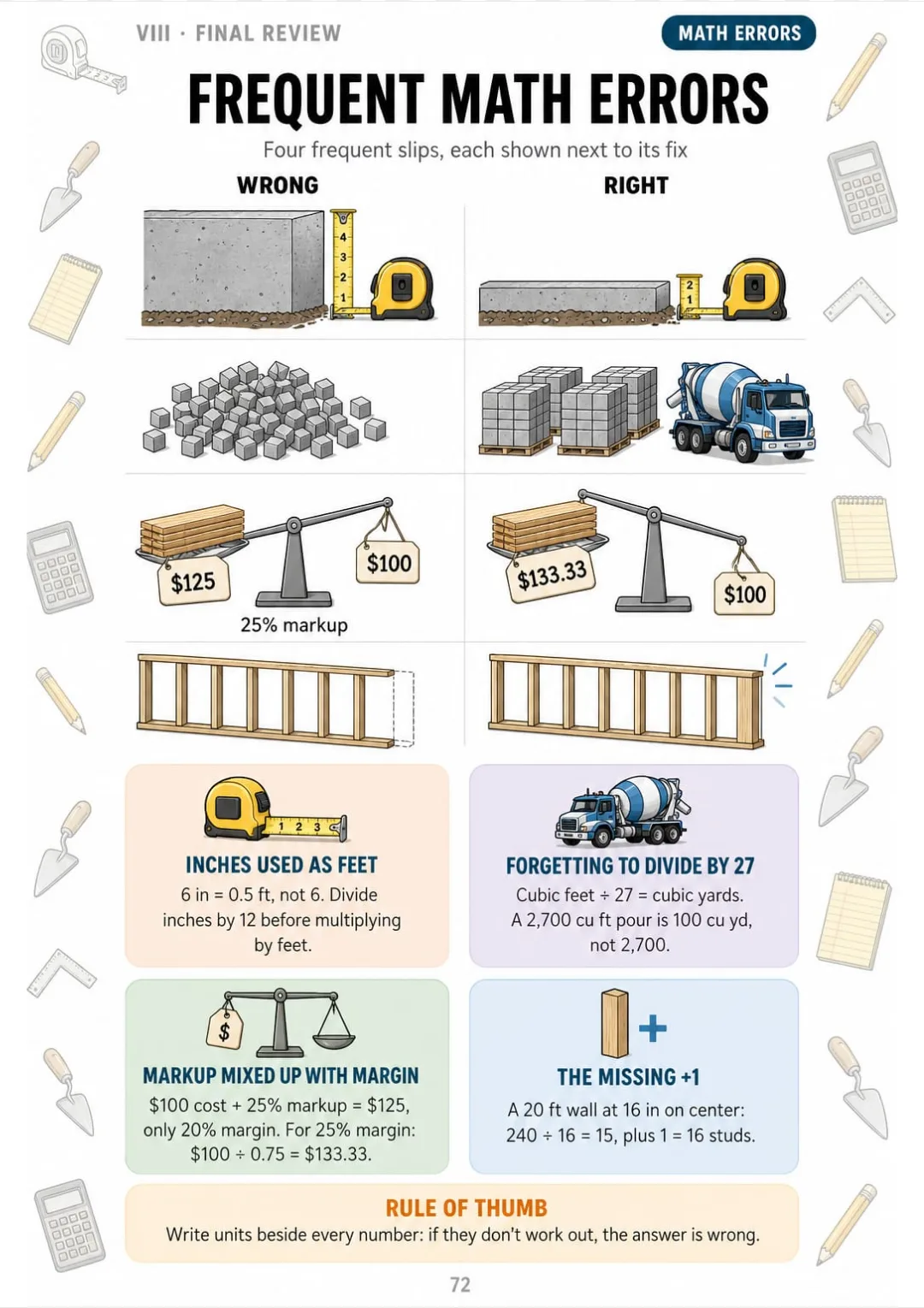
Plan scales, soil swell, block counts, OSHA fall protection, contract types, critical path, and markup vs. margin: in your notes, they're a wall of text. Here, each one gets its own page, with the drawing and what to remember, plus a 4-step routine for open-book lookups. Common content only: state law and state exams aren't included. 75 drawn pages.
🔒 Secure checkout · PDF by email · 30-day guarantee
One topic per page, the drawing that shows you how it works, and the boxes with what you need to know:


Swipe to see more →
These are real pages from the book. The table of contents is the full one: 8 parts and 70 topics.
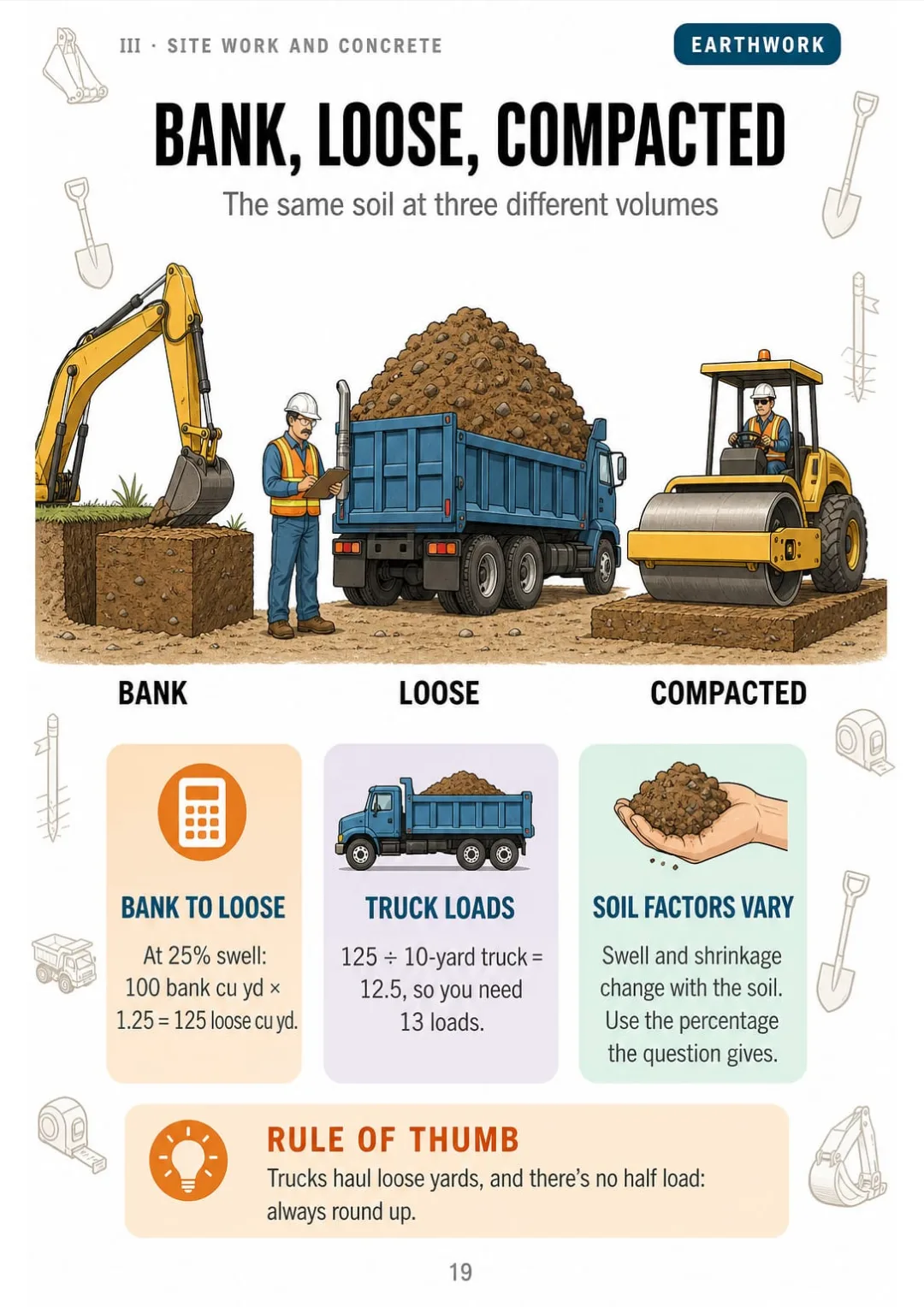
You've read about bank, loose, and compacted yards three times. You close the book...
...and you no longer know which number goes up, which goes down, and how many trucks you need. It was just one line after another.

Here, that same dirt is one drawn page: 100 bank cubic yards plus 25% swell become 125 loose cubic yards, and that's 13 loads in a 10-yard truck.
And on the pages around it, each topic has its own: cut and fill, compaction, cubic yards in a slab, rebar sizes, and counting bars in a mat.
First you understand why it works that way. Then the order stays with you on its own.

Your exam and your books, plans and core math, site work and concrete, masonry, steel, wood and finishes, OSHA safety, running the project, the business numbers, and final review: 75 pages, all drawn
What if each topic fit on a single page?
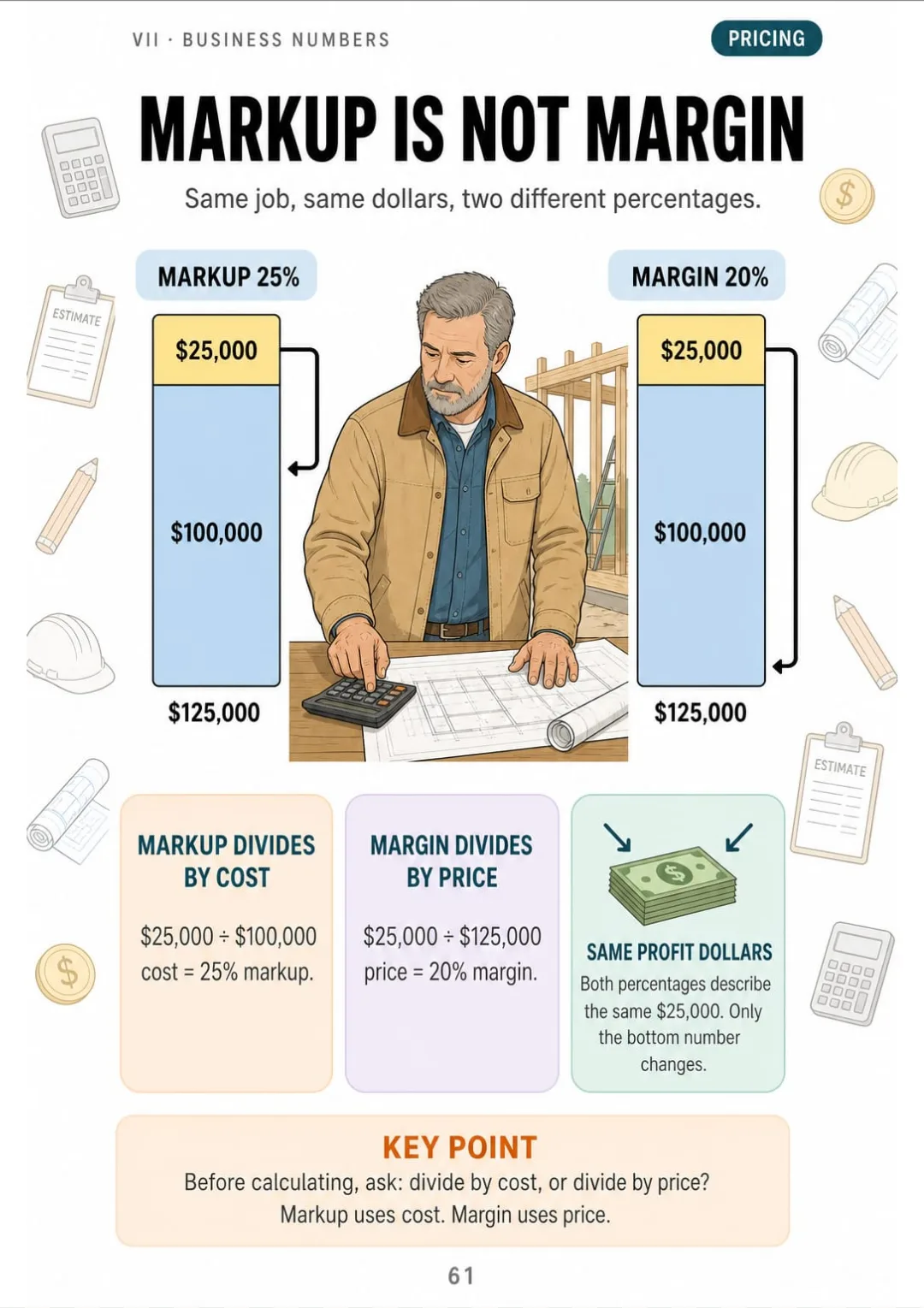
Instead of rereading half a page on markup and margin without being able to see the difference...
...you open the page and find the same job worked out in numbers: 100,000 of cost plus 25% markup is a 125,000 price, and that's only a 20% margin.

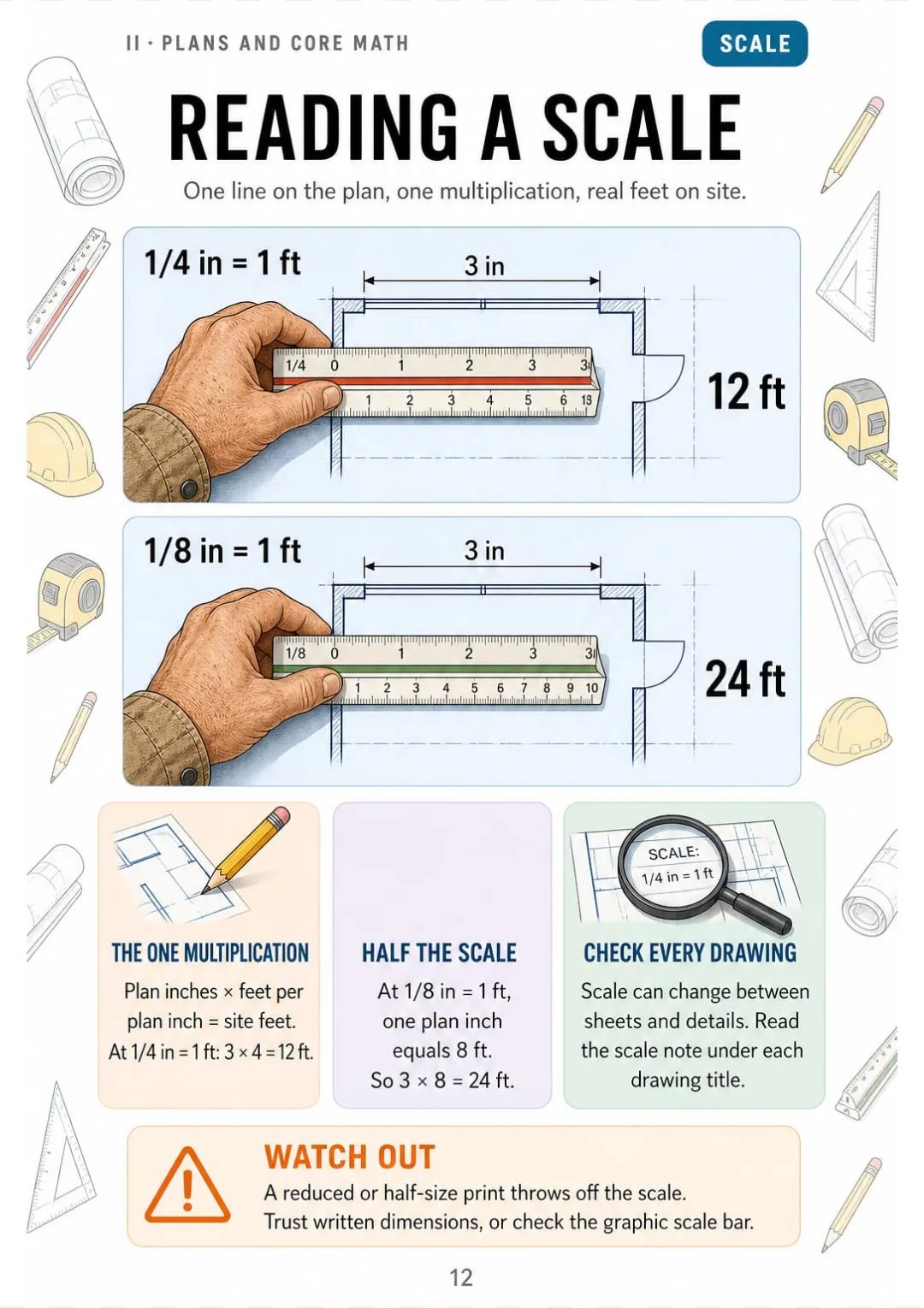
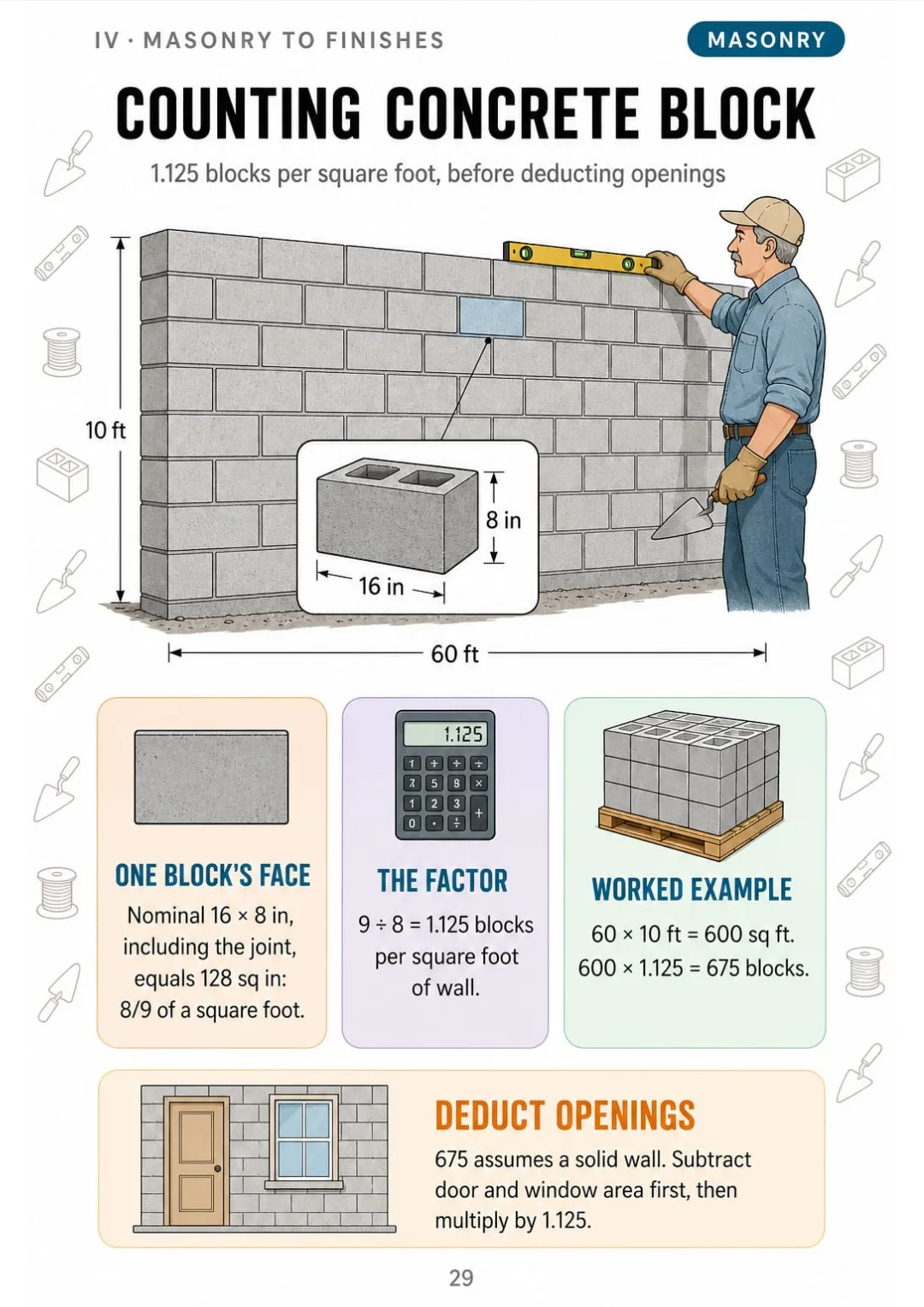
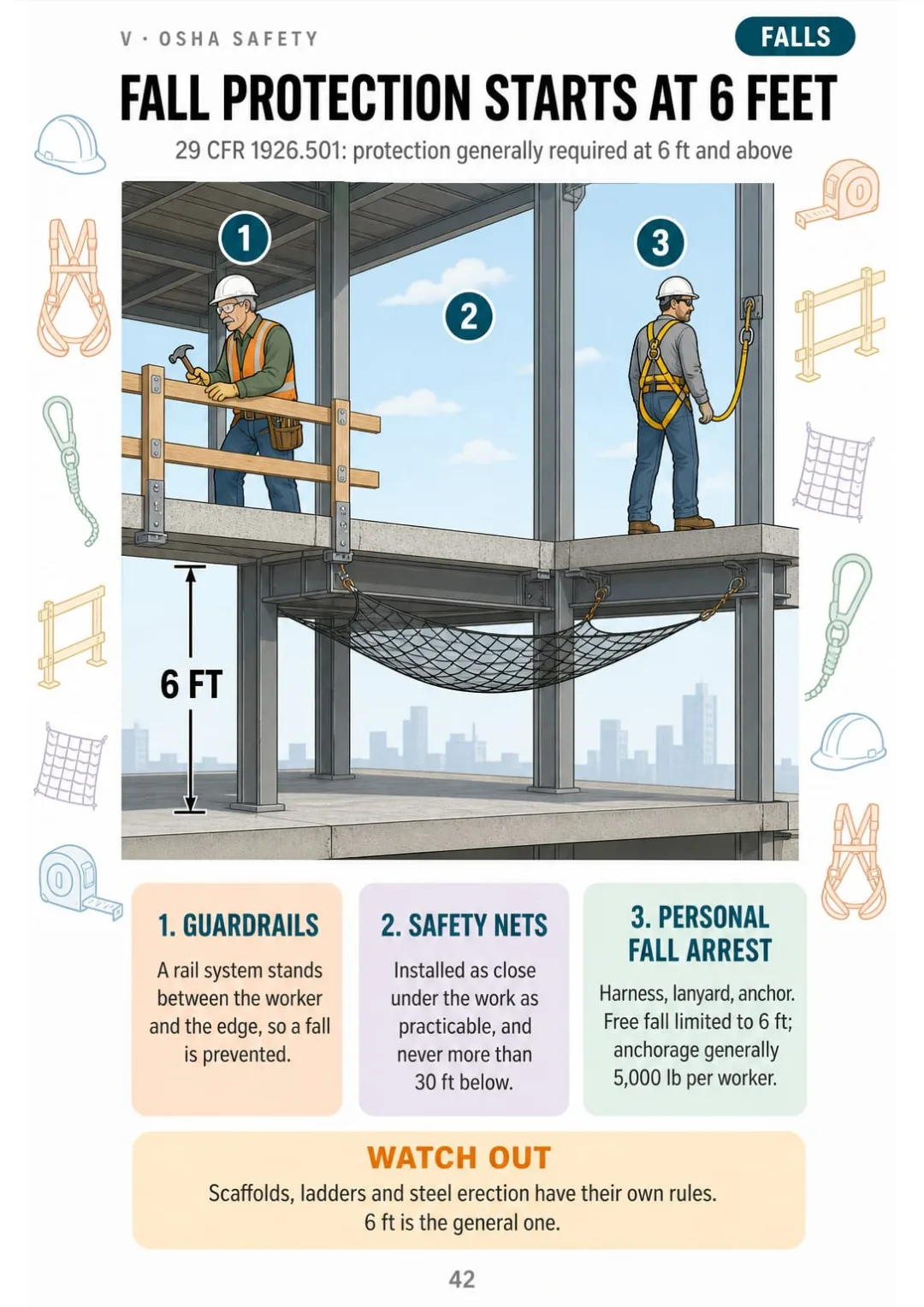
And plan scales, concrete block, fall protection, bonds, and critical path become drawings and tables you can read at a glance.
You stop memorizing and start understanding.
That's exactly what The Contractor Exam Sketchbook does. It's not “another study guide.” It's 8 parts and 70 drawn topics, and at the end, all the formulas on one page and your pre-exam checklist.
Because what your brain sees organized, it remembers.
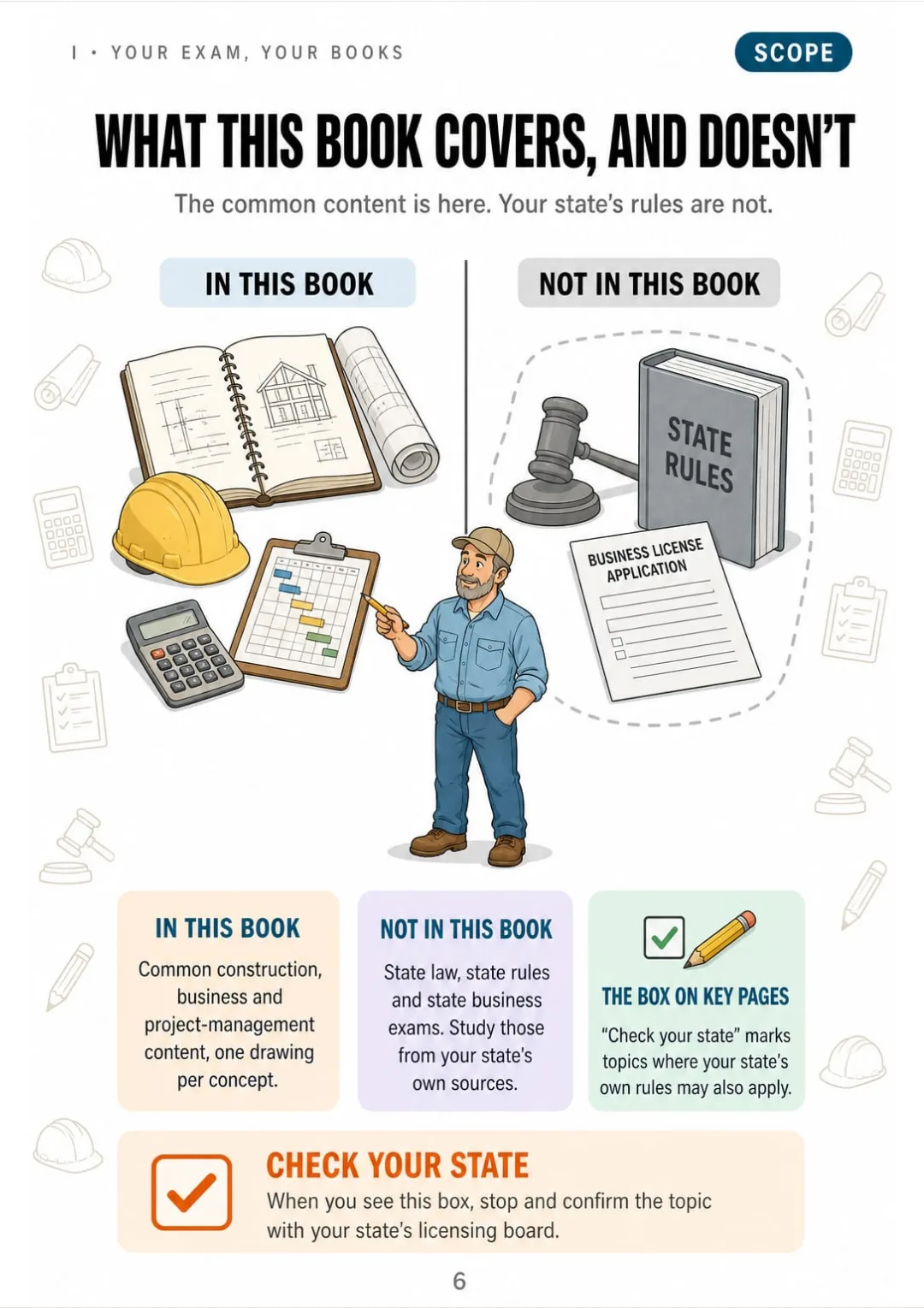
Know what to bring and how to search your books: what this book covers and what it doesn't, your candidate bulletin, the 4-step lookup routine, tabbing by topic, managing your time in two passes, and reading the question before the numbers.
Go from the sheet to the number: reading a scale, the spec division map, when plans and specs disagree, area in three shapes, conversions, squaring a corner with 3-4-5, and slope and grade.
See the dirt and concrete numbers worked out: bank, loose, and compacted soil, cut and fill, 95% compaction, the 1-acre stormwater trigger, cubic yards in a slab, water-cement ratio, slump and cylinders, rebar, and concrete cover.
Count and read materials trade by trade: counting block, mortar types, reading a W14×90, steel erection, board feet, lumber sizes, studs, sheathing, roofing squares, R-value, fire doors, drywall, and paint.
Keep the OSHA numbers at a glance: fall protection, guardrails, ladders, scaffolds, trenches, soil types, trench access and spoil, the competent person, injury reporting and recordkeeping, and hazard communication.
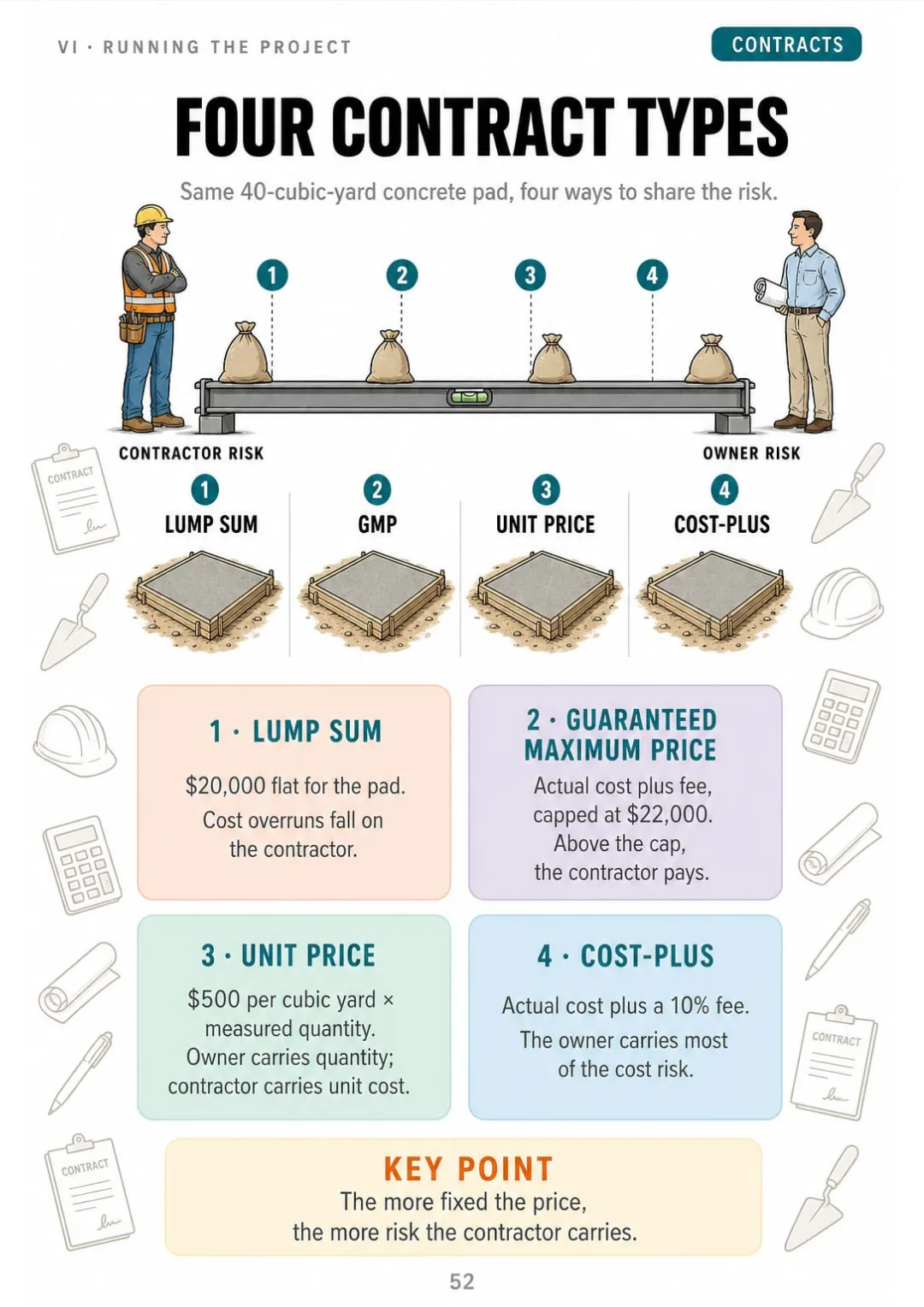
See how the contract and the schedule fit together: four contract types, bonds, insurance, change orders, liquidated damages, retainage, critical path, float, and crew days and labor cost.
Tell markup from margin and read the numbers: markup vs. margin, pricing to a target margin, labor burden, payroll taxes, overtime, hiring paperwork, the balance sheet, ratios, percentage of completion, over- and underbilling, and break-even volume.
Have your final review in one place: common math mistakes, common lookup mistakes, all the formulas on one page, and your pre-exam checklist.
At the end of the book: All the formulas on one page, common math and lookup mistakes, and a pre-exam checklist.
Practice concrete volume, area, takeoffs, markup vs margin, payroll burden and critical path float with extra exam-style problems, each worked in the same steps as the book.

Review the terms at a glance on printable cards, with the term on the front and a one-line definition plus a tiny sketch on the back.
📄 This is a digital PDF book sent to your email: nothing is printed or shipped.
PDF by email: The Contractor Exam Sketchbook reaches your inbox as a PDF, and the two free books come by email too. One-time payment, no installments or hidden costs.
Scales, takeoffs, OSHA numbers, and the business math, one topic per page, to review after work.
The 4-step lookup routine for the books your bulletin allows, plus all the formulas on one page for your final review.
A drawn review of what you don't use every day: critical path by hand, markup vs. margin, bonds, and percentage of completion.
📄 This is a digital PDF book sent to your email: nothing is printed or shipped.
30-day guarantee: tell us what didn't work and we'll refund 100%.
You have 30 days to try The Contractor Exam Sketchbook and the two free books. Tell us what didn't work, whether it's the content, a file, or anything else, and we'll refund 100% of what you paid. One-time payment, no subscriptions and no surprises.
The Contractor Exam Sketchbook comes as a PDF by email, sent to the address you enter at checkout, to read on your phone or print. The two free books, Construction Math Workbook and 300 Exam Terms on Cards, also come as PDFs by email.
A one-time payment, the price shown above. No installments and no subscription. Any extras offered when you pay are optional: you only pay for them if you add them.
For people going for a commercial general contractor license and studying the common content of the NASCLA exam: tradespeople moving into running jobs, project managers, superintendents, small builders, and anyone retaking it. It assumes you know the trade, not that you remember the math: the math is worked step by step. Not every state uses this exam, so check your state board's candidate bulletin before you buy. Your state's separate law, rules, and business exams are not included: key pages carry a “Check your state” box that sends you to that bulletin.
The candidate bulletin for the NASCLA Accredited Examination for Commercial General Building Contractors and its content outline, plus OSHA regulations 29 CFR Parts 1926 and 1904. The drawings and worked examples are our own: no text, tables, or figures are copied from the reference books.
No. It's independent study material, not affiliated with or endorsed by NASCLA, PSI, OSHA, or any state licensing board. It gives you no certificate and no course credit toward a license. For the number of questions, time, passing score, and allowed books, go by your candidate bulletin.
Because the allowed books are made for looking things up, not for learning what to look for. This one teaches the principles with drawings and gives you a 4-step routine for finding answers in those books. It doesn't copy them, and it doesn't replace them or a licensing course.
No. They're written for this book and aren't official questions from any exam. They're there to help you practice.
Yes. It's a PDF, so you can print all of it or just the pages you want. Whether printed notes can go into the exam room is up to your bulletin, so check it first.
30-day guarantee: tell us what didn't work and we'll refund 100%.
You don't have to reread the same page hoping it sticks this time.
You don't have to memorize formulas you can't picture.
And you definitely don't have to walk into the exam not knowing where to start.
You've seen the real pages. If that's how you want to study, the book and the 2 free ones come as PDFs by email, and you have 30 days to tell us what didn't work and get 100% back.
One-time payment: US$ 27 · Guarantee: 30 days · PDF by email
YES, I WANT THE CONTRACTOR EXAM SKETCHBOOK FOR US$ 27📄 This is a digital PDF book sent to your email: nothing is printed or shipped.